
How a sales funnel works in ClickFunnels is defined by a systematic transition from anonymous web traffic to loyal, high-value customers through a series of automated, psychologically driven stages. Unlike a traditional website that acts as a digital brochure, a sales funnel is a linear path designed to eliminate choice paralysis and drive a specific action.
By leveraging a structured architectural approach, businesses can automate lead acquisition, nurture relationships with precision, and maximize the average order value (AOV) through strategic upselling. In the modern digital economy, understanding the mechanics of these systems is no longer optional for those seeking scalable growth; it is the fundamental infrastructure of online commerce.
Quick Insights
- Conversion Efficiency: Properly structured funnels often outperform traditional websites by 200–300% in lead generation.
- Average Order Value: One-click upsells within the platform typically increase initial transaction value by 15–25%.
- The “Rule of 7”: Automation sequences ensure prospects receive the necessary touchpoints (industry average is 7–10) before a purchase decision.
- Split-Testing Power: Continuous A/B testing on landing pages can reduce customer acquisition costs (CAC) by up to 50%.
- All-in-One Infrastructure: The platform integrates hosting, payment processing, email automation, and CRM into a single ecosystem.
How Does the ClickFunnels Architecture Streamline the Buyer’s Journey?
The core logic of how a sales funnel works in ClickFunnels revolves around a concept known as the “Value Ladder.” As a prospect moves deeper into the funnel, the value of the offering increases, as does the price. The software facilitates this by creating a controlled environment where the user is presented with only one decision at a time.
This architectural precision is what separates high-growth SaaS and digital product companies from those struggling with stagnant conversion rates. By stripping away navigation bars and external links, the software forces the visitor to focus entirely on the offer at hand. This “narrowed focus” is the primary driver of the platform’s high ROI.
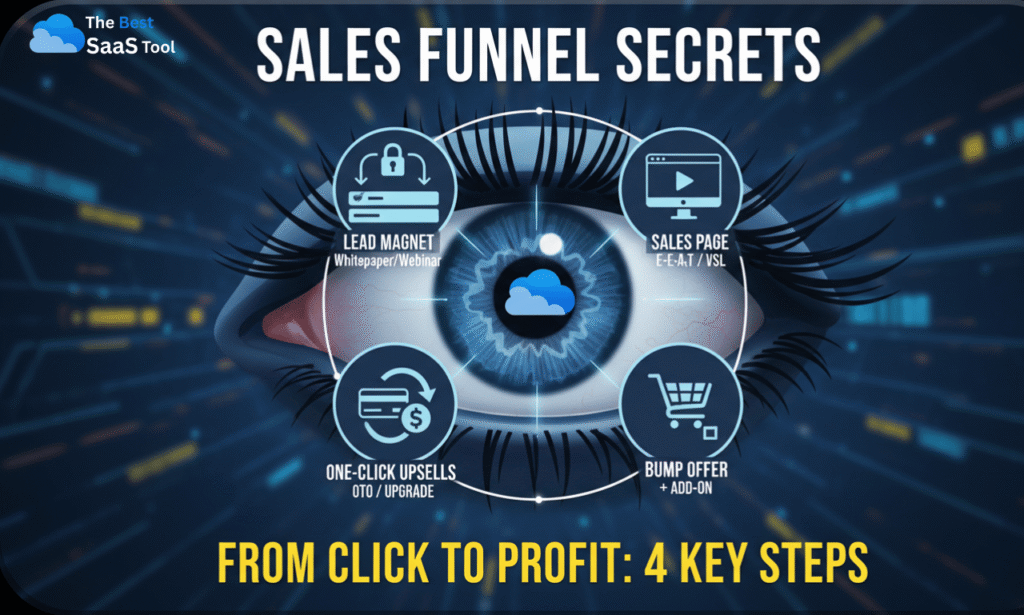
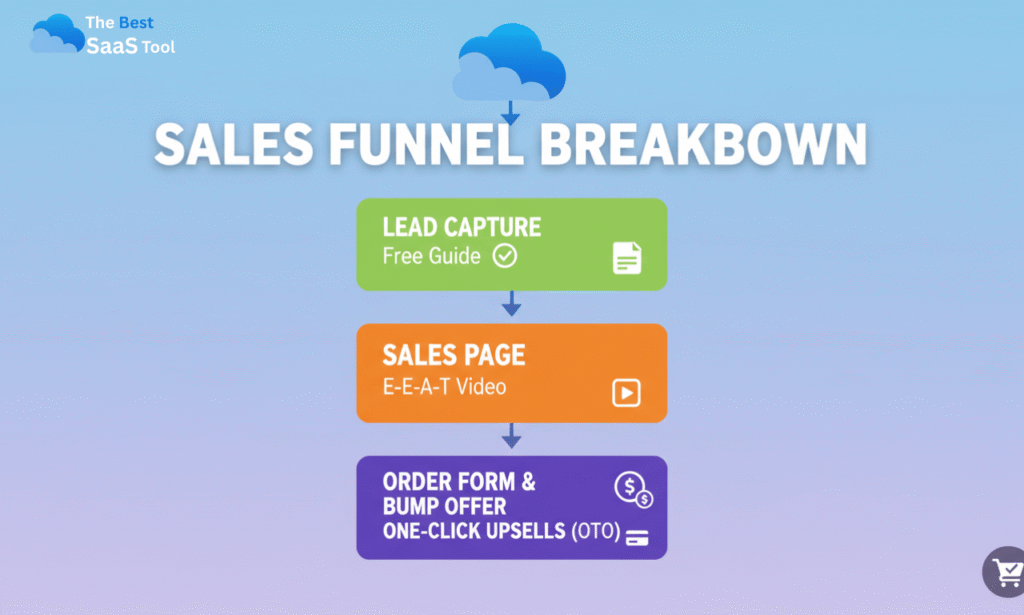
- Lead Capture (The Squeeze Page): The journey begins with a low-friction request. By offering a “lead magnet” (such as a whitepaper or webinar), the system captures contact information, moving the user from the “Awareness” stage to the “Interest” stage.
- The Sales Page: Once the lead is captured, the system automatically redirects the user to a high-converting sales page. This page uses long-form or video sales letters (VSLs) to establish E-E-A-T (Experience, Expertise, Authoritativeness, and Trustworthiness).
- The Order Form & Bump Offer: Before checking out, the user is presented with a “Bump Offer”—a small, relevant add-on that requires only a checkbox to include. This is a critical step in how a sales funnel works in ClickFunnels to ensure immediate profitability.
- One-Click Upsells (OTO): After the initial purchase, the software retains the payment data to offer a “One-Time Offer” (OTO). This allows the customer to upgrade their purchase without re-entering credit card details, significantly lowering friction.
What are the Benchmarks for Sales Funnel Performance in 2026?
To evaluate the success of a digital sales infrastructure, it is essential to compare internal data against global performance standards. Current data shows a widening gap between average performers and “elite” funnels that utilize advanced automation and AI-driven personalization.
The following table outlines the current performance standards for digital product funnels.
2026 Sales Funnel Conversion Benchmarks
| Funnel Stage | Industry Average | Top 10% Performers | Key Metric to Watch |
| Visitor to Lead | 1.5% – 2.5% | 8.0% – 15.0% | Opt-in Rate |
| Lead to Sale | 1.0% – 2.0% | 5.0% – 7.0% | Sales Conversion |
| Upsell Take Rate | 10.0% – 15.0% | 25.0% – 30.0% | Attach Rate |
| Average Order Value | $45.00 | $110.00+ | AOV |
| Customer LTV | 3x CAC | 7x+ CAC | Long-term ROI |
“The primary shift we have seen in 2026 is that the ‘static’ funnel is dead. Success now depends on dynamic pathing—where the software identifies a user’s intent in real-time and adjusts the offer sequence to match their specific pain points.”
— Julian V. Sterling, Lead Strategist at Global Conversion Labs
Why did Sales Funnel Automation Emerge as the Standard?
Historically, online sales relied on the “Storefront Model.” Businesses would drive traffic to a homepage and hope the visitor would find what they needed. However, as digital noise increased, conversion rates plummeted. Research indicated that 79% of marketing leads never converted into sales because of a lack of nurturing.
The emergence of the ClickFunnels model in 2014 revolutionized this by introducing the Direct Response Funnel. This shifted the focus from “browsing” to “guided conversion.” By automating the follow-up process via “Follow-Up Funnels” (email/SMS sequences), businesses could stay top-of-mind without manual intervention, effectively solving the problem of lead leakage.
In the past, building such a system required a team of developers, designers, and copywriters. The democratization of these tools allowed small-to-medium enterprises (SMEs) to compete with global corporations by implementing sophisticated pricing models and scalability features that were previously cost-prohibitive.
How do the Different Funnel Types Serve Specific Business Goals?
Understanding how a sales funnel works in ClickFunnels requires recognizing that not all funnels are built for the same purpose. The platform utilizes specific templates tailored to different stages of the business lifecycle:
1. The Tripwire Funnel
This is designed to turn cold traffic into customers quickly. By offering an irresistible low-ticket item (usually $7–$27), the business covers its advertising costs. Once the customer has their credit card out, the funnel introduces higher-ticket “Core Offers.”
2. The Webinar Funnel
Used for high-ticket SaaS, software, or consulting. It automates the registration, reminder, and replay process. This funnel type is particularly effective for complex products that require significant education before a purchase decision can be made.
3. The Product Launch Funnel
Inspired by the “Jeff Walker” style, this funnel releases content over several days to build anticipation. This sequence triggers psychological triggers like scarcity and social proof, culminating in a limited-time sales window that drives massive volume in a short period.
4. The Membership Funnel
Focuses on recurring revenue by gating content behind a subscription paywall. The software manages the user’s access levels, ensuring that security and performance are maintained as the community scales.
What is the “Micro-Moment” Framework for Funnel Optimization?
To maximize ROI, elite marketers use the Micro-Moment Framework. This strategy focuses on optimizing the tiny windows of time where a user makes a micro-commitment. When analyzing how a sales funnel works in ClickFunnels, this framework is the “secret sauce” for conversion.
- The 3-Second Rule: The landing page must communicate the “What’s in it for me?” within three seconds to prevent a bounce. If the headline doesn’t resonate immediately, the rest of the funnel is irrelevant.
- The Curiosity Gap: Use headlines that provide enough information to be interesting, but leave a “gap” that can only be filled by clicking or opting in. This leverages the “Zeigarnik Effect,” where the human brain seeks to close incomplete loops.
- The Social Proof Stack: Strategically place testimonials, case studies, and “As Seen On” badges near the call-to-action (CTA) buttons. This reduces buyer remorse at the point of purchase.
- The Friction Filter: Every additional field in an opt-in form reduces conversion by approximately 11%. Use “Two-Step” opt-ins where the user clicks a button before seeing the form to trigger the “Commitment and Consistency” principle.
Learn more ClickFunnels Review: 7 Powerful Insights You Must Know
How to Scale a Funnel for Long-Term ROI?
Scalability is the hallmark of a healthy digital product. Once a funnel is “profitable at the break-even point” (meaning the initial sale covers the cost of the advertisement), it can be scaled infinitely. This is where the true power of how a sales funnel works in ClickFunnels becomes evident.
The Scalability Checklist
- Pixel Integration: Ensure tracking pixels are firing correctly for retargeting. Without data, scaling is just gambling.
- Mobile Optimization: In 2026, over 75% of funnel traffic originates from mobile devices; ensure the “one-click” experience is seamless on small screens.
- Load Speed: A 1-second delay in page load time can result in a 7% reduction in conversions. Use compressed images and clean scripts.
- Backend Diversification: Use the customer data captured to sell “backend” products through automated email sequences. This is where the highest profit margins reside.
- Global CDN: Ensure your funnel is hosted on a Content Delivery Network to provide high performance and low latency regardless of the visitor’s location.
What Common Mistakes Sink Funnel Performance?
Even with the best tools, certain strategic errors can lead to a “leaky funnel” where ad spend is wasted. Understanding these pitfalls is essential for anyone researching how a sales funnel works in ClickFunnels.
- Over-Complicating the Offer: Offering too many choices on a single page leads to decision fatigue. Stick to one goal per page. If you want them to buy, don’t ask them to “follow you on Twitter” at the same time.
- Ignoring the “Thank You” Page: The page immediately after a purchase is the moment of highest engagement. Use it to offer a “Fast Action” bonus, invite them to a community, or provide an immediate “Success Path” for their new purchase.
- Weak Hook-Story-Offer Alignment: If your ad promises a “Free Checklist” but the funnel immediately tries to sell a $500 course without context, the “Story” is broken. The transition must feel natural and helpful.
- Lack of Retargeting: 98% of first-time visitors will not buy. Without a retargeting funnel (showing ads to people who visited but didn’t convert), you are leaving the majority of your potential revenue on the table.
How does ClickFunnels Address Modern Security and Data Privacy?
As global regulations like GDPR and CCPA become more stringent, the technical standards of how a sales funnel works in ClickFunnels have evolved. Security is no longer a “feature”—it is a requirement for maintaining consumer trust.
- SSL Encryption: Every funnel is automatically equipped with SSL certificates to ensure that customer data and payment information are encrypted during transit.
- PCI Compliance: By integrating with major payment gateways like Stripe and PayPal, the platform ensures that sensitive financial data never touches the business’s local servers, reducing liability.
- Data Portability: Modern funnels allow users to request their data or be forgotten, ensuring that the business remains compliant with international privacy laws.
- Fraud Protection: Integrated AI tools now monitor for bot traffic and fraudulent transactions, protecting the merchant’s merchant account standing and ensuring high scalability.
What is the Future of Sales Funnels and AI Integration?
As we look toward the future of how a sales funnel works in ClickFunnels, the integration of Artificial Intelligence is the dominant trend. We are moving away from “linear” funnels toward “Predictive Funnels” that adapt in real-time.
Hyper-Personalization
AI agents will soon be able to rewrite sales copy in real-time based on the visitor’s geographic location, past browsing history, and even the sentiment of their social media profiles. This means two different people visiting the same URL may see entirely different headlines tailored to their specific personality types.
Voice-Activated Funnels
With the rise of smart assistants, “Voice Opt-ins” will become a standard feature. A user might say, “Add that free guide to my library,” and the funnel will automatically process the lead using the voice profile’s linked email address.
Autonomous Optimization
The next generation of funnel builders will likely include “Self-Healing” capabilities. If an A/B test determines that a green button is outperforming a red one, the system will automatically swap them across the entire funnel without human intervention. This ensures the highest possible ROI at all times.
Why a Sales Funnel is the Ultimate Business Security?
In an era of fluctuating ad costs and changing social media algorithms, owning a high-performing sales funnel provides a level of business security that no social media platform can offer. By owning the customer list and controlling the entire conversion path, a business becomes less dependent on third-party platforms.
The ROI of a well-constructed funnel is not just measured in immediate sales, but in the Lifetime Value (LTV) of the customers it acquires. When a business masters the mechanics of how a sales funnel works in ClickFunnels, they transition from “chasing” sales to “predicting” revenue. This predictability is what allows for aggressive reinvestment and market dominance.
How to Implement the “Ascension” Model for SaaS Growth?
For SaaS and software companies, the sales funnel doesn’t end at the first purchase. It is a continuous loop of value delivery.
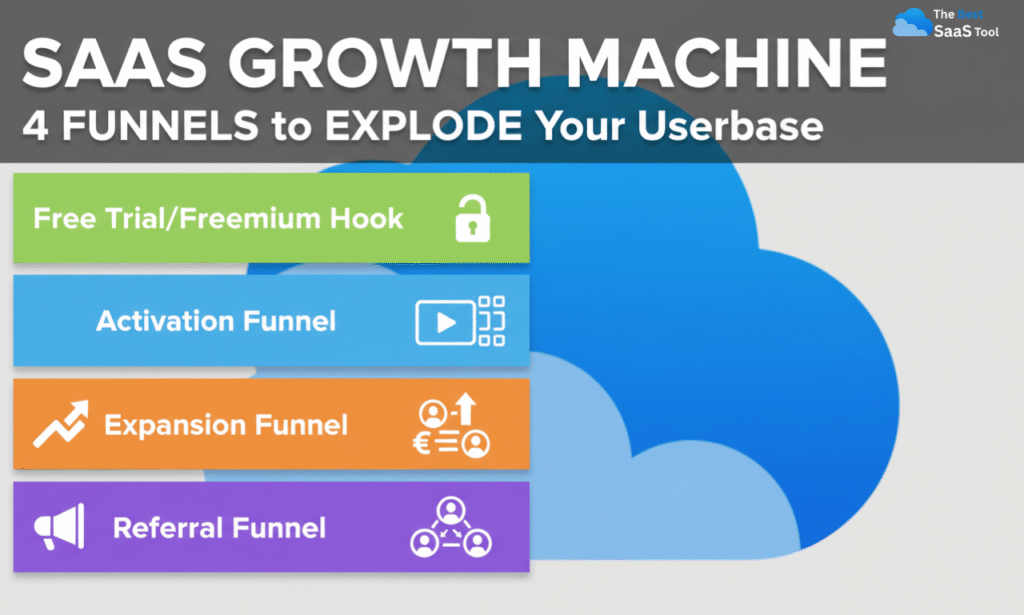
- The Free Trial/Freemium Hook: Lowers the barrier to entry and gets the user “into the ecosystem.”
- The Activation Funnel: An automated series of videos or walkthroughs designed to get the user to their first “Aha!” moment with the software.
- The Expansion Funnel: Once a user is active, the funnel triggers offers for higher tiers, more seats, or advanced features based on their usage patterns.
- The Referral Funnel: Turning existing customers into advocates by offering incentives for sharing the product within their network.
Mastering the Science of Conversion
The mastery of sales funnels represents the intersection of technology and human psychology. By understanding the linear progression from awareness to advocacy, businesses can create a predictable engine for growth. Whether you are selling a $10 e-book or a $10,000 enterprise software solution, the principles of friction reduction, value delivery, and automated follow-up remains the gold standard for digital commerce.
The long-term value of this approach lies in its ability to be measured, tested, and improved. In a world where data is the new currency, a sales funnel is the mint. Those who understand how a sales funnel works in ClickFunnels and apply these principles with discipline will find themselves at the forefront of the digital economy, while those clinging to traditional websites will continue to struggle with rising costs and declining attention spans.
The fundamental shift is moving from a passive “wait and see” strategy to an active “guide and convert” strategy. This proactive approach to customer acquisition is not just a marketing tactic; it is the cornerstone of a resilient, scalable, and highly profitable modern business.