
In the rapidly evolving digital landscape of 2026, automotive email marketing remains the undisputed king of Return on Investment (ROI).
While social media algorithms fluctuate and search engine landscapes shift, your email list represents “owned media”—a direct, un-interrupted line to your customers.
For modern car dealerships, service centers, and auto parts retailers, email isn’t just a way to send newsletters; it’s a sophisticated tool for nurturing leads from the first “just looking” click to the final “out the door” purchase and every service appointment in between.
Table of Contents
Table of Contents
1. Why Automotive Email Marketing Still Wins in 2026
Despite the rise of decentralized social platforms and AI search bots, email marketing in the automotive industry continues to outperform other digital channels by a significant margin.
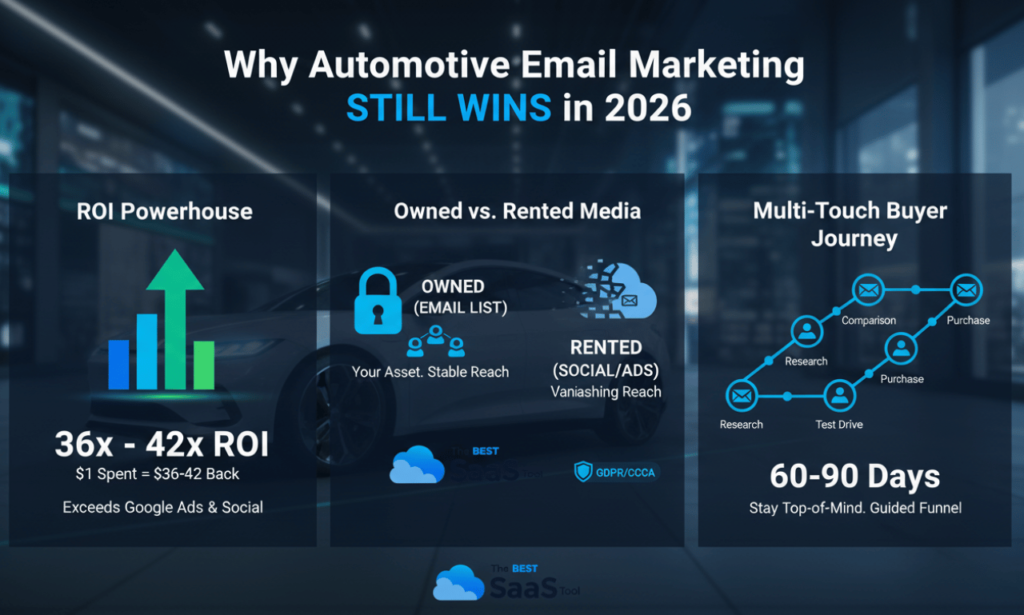
The ROI Powerhouse
Recent data shows that for every $1 spent on automotive email marketing, dealerships see a return of $36 to $42. This far exceeds the average performance of Google Ads or paid social campaigns.
Why? Because email targets a “warm” audience—people who have already expressed interest in your inventory or services.
Owned Media vs. Rented Media
When you rely on social media, you are “renting” your audience. A platform can change its algorithm overnight, slashing your organic reach.
Your email database is an asset you own. In 2026, as data privacy regulations like GDPR and CCPA become even more stringent, having a first-party data strategy built on a robust email list is essential for long-term stability.
The Multi-Touch Buyer Journey
Buying a car is rarely an impulsive decision. It is a journey that often takes 60 to 90 days and involves dozens of touchpoints. Email allows you to remain “top-of-mind” throughout this cycle by providing timely, relevant information that guides the buyer through the funnel.
2. Emerging Trends: What’s New for 2026?
The “spray and pray” method of sending generic mass blasts is officially dead. To succeed today, your strategy must be leaner, smarter, and more personalized.
AI-Driven Hyper-Personalization
In 2026, AI is no longer a luxury—it’s the engine. Advanced Customer Relationship Management (CRM) systems now use predictive analytics to determine when a customer is most likely to open an email and what vehicle model they are likely to be interested in next.
Zero-Party Data Collection
With the total phase-out of third-party cookies, dealerships are turning to zero-party data. This is data that customers intentionally share with you. Smart automotive marketers use interactive emails—such as “Build Your Dream SUV” quizzes or “Value Your Trade” calculators—to collect specific preferences directly from the source.
Interactive and Lighter Design
Emails in 2026 are moving toward a “minimalist but interactive” aesthetic. Instead of heavy, image-laden files that trigger spam filters, successful campaigns use:
- Carousels: To let users swipe through car interiors without leaving the inbox.
- Dark Mode Optimization: Ensuring designs look premium regardless of the user’s interface.
- AMP for Email: Allowing customers to book a test drive directly within the message.
3. Core Automotive Email Campaigns You Must Run
To build a high-converting machine, your dealership needs a mix of automated (lifecycle) and manual (promotional) campaigns.
A. The Welcome Series (First Impressions Matter)
When a lead signs up on your website, they are at their peak level of interest. A three-part welcome sequence should:
- Immediate: Introduce the dealership’s unique value proposition (e.g., “Family-owned for 30 years”).
- Day 2: Highlight customer testimonials and “Social Proof.”
- Day 4: Provide a low-friction “Call to Action” (CTA), like an invitation to a virtual showroom tour.
B. Behavioral Triggers (The Secret Sauce)
Behavioral emails are triggered by specific actions. If a user views a Ford F-150 listing three times in 24 hours but doesn’t inquire, an automated “Still thinking about the F-150?” email can be sent with a personalized video walk-around.
C. Service Reminders (The Retention Engine)
Service departments are the lifeblood of dealership profitability. Automated service reminders based on mileage or time intervals (e.g., “It’s time for your 30,000-mile check-up”) achieve some of the highest open rates in the industry, often exceeding 60%.
D. Re-engagement (Winning Back “Ghost” Leads)
If a lead hasn’t engaged in 90 days, don’t delete them. Send a “We Miss You” campaign featuring an exclusive “Loyalty Discount” or an update on the latest tech features in the models they previously viewed.
4. Advanced Segmentation Strategies
Segmentation is the difference between an email that gets opened and one that gets deleted. In the automotive world, you should segment your list by:
| Segment Type | Description | Goal |
| Lifecycle Stage | New leads vs. recent buyers vs. long-term service customers. | Move them to the next stage of the funnel. |
| Interest Category | Luxury seekers vs. eco-conscious vs. performance enthusiasts. | Send relevant inventory updates (e.g., EVs to the eco-conscious). |
| Financial Status | Cash buyers vs. lease-enders vs. finance seekers. | Tailor the offer (e.g., “End of lease options”). |
| Geographic | Local vs. out-of-state buyers. | Promote local dealership events or shipping options. |
5. Optimizing for the Modern Inbox: Technical Best Practices
To ensure your automotive email marketing actually reaches the inbox, you must adhere to modern deliverability standards.
Authentication (SPF, DKIM, DMARC)
Mailbox providers like Google and Apple are stricter than ever. If your domain isn’t properly authenticated using SPF, DKIM, and DMARC, your emails will likely end up in the “Promotions” tab—or worse, the spam folder.
Mobile-First is the Only Way
Over 65% of automotive emails are opened on mobile devices. If your “View Inventory” button is too small to tap with a thumb, you are losing sales. Use a single-column layout and large, high-contrast CTA buttons.
Subject Line Science
The best-performing subject lines in 2026 are:
- Short: Under 40 characters for mobile visibility.
- Action-Oriented: “Your test drive is waiting.”
- Personalized: “John, your Audi A4 service is due.”
Pro Tip: Avoid “Spam Trigger” words like “100% Free,” “No Credit Check,” or excessive exclamation marks. These can drastically lower your sender reputation.
6. Measuring Success: The Metrics That Matter
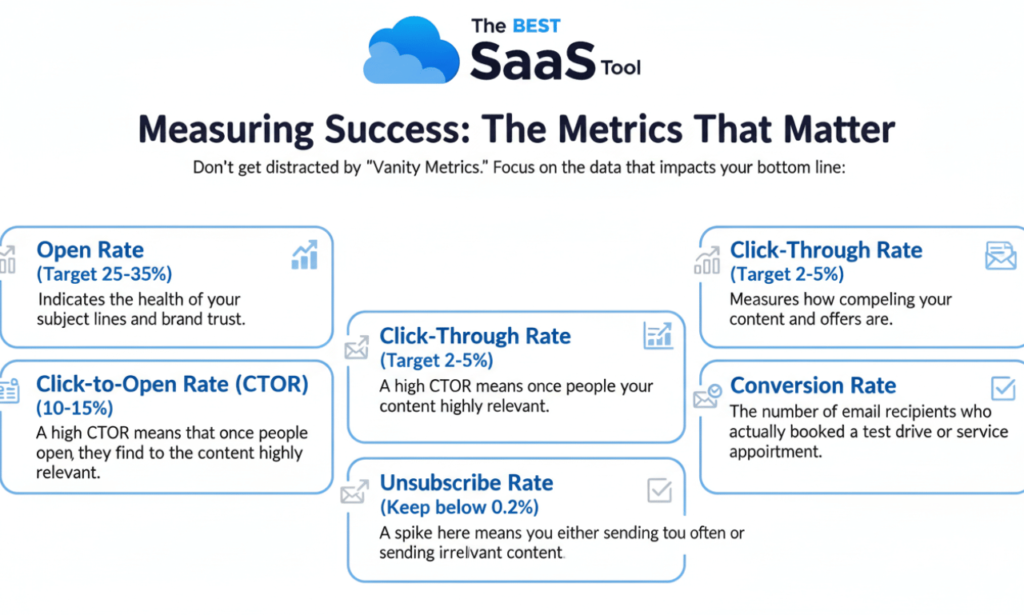
Don’t get distracted by “Vanity Metrics.” Focus on the data that impacts your bottom line:
- Open Rate (Target 25-35%): Indicates the health of your subject lines and brand trust.
- Click-Through Rate (Target 2-5%): Measures how compelling your content and offers are.
- Click-to-Open Rate (CTOR): A high CTOR (10-15%) means that once people open your email, they find the content highly relevant.
- Conversion Rate: The number of email recipients who actually booked a test drive or service appointment.
- Unsubscribe Rate (Keep below 0.2%): A spike here means you are either sending too often or sending irrelevant content.
7. Frequently Asked Questions (FAQ)
How often should a dealership send emails?
For general newsletters, once a week is a gold standard. However, automated behavioral emails (like service reminders or abandoned browse alerts) should be sent as they are triggered. Quality always beats quantity.
Is email marketing better than SMS for car sales?
They work best together. Use email for detailed information, storytelling, and high-res imagery. Use SMS for time-sensitive alerts, like “Your car is ready for pickup” or “Your appointment is in 1 hour.”
What is the best time to send automotive emails?
In 2026, the trend has shifted toward late-day engagement. Emails sent between 6 PM and 9 PM on Tuesday or Thursday often see the highest engagement, as buyers browse their options after work. Saturday mornings are also highly effective for driving weekend showroom traffic.
How do I grow my automotive email list?
Use high-intent lead magnets on your website, such as “Download the 2026 EV Buyer’s Guide” or “Get an Instant Trade-In Quote.”
Ensure every person who walks into your showroom or service bay is asked for their email address and explicit consent to receive updates.
Conclusion: The Roadmap to 2026 Success
Mastering automotive email marketing in 2026 requires a balance of high-tech automation and high-touch personalization.
By leveraging AI to understand buyer intent and focusing on providing genuine value rather than just “selling,” your dealership can build a loyal community that returns for every new car and oil change.
The brands that win are those that treat the inbox with respect—sending the right message, to the right person, at the perfect moment in their journey.
Learn more: Email Marketing Customer Journey: 5 Proven Stage’s to Grow ROI