
The modern email marketing customer journey is no longer a linear path but a sophisticated, behavior-driven ecosystem.
In an era where 4.5 billion people use email daily, the “batch and blast” era has been replaced by hyper-personalized lifecycle stages that adapt to real-time user signals.
By aligning messaging with specific milestones—from initial awareness to long-term advocacy—organizations can achieve an average ROI of $36 for every $1 spent, outperforming nearly every other digital channel.
An effective journey map functions as a blueprint for trust. It ensures that a SaaS trial user receives technical onboarding support, while a repeat retail customer receives loyalty rewards, rather than generic promotional noise.
When executed with precision, this framework reduces churn, accelerates the sales cycle, and transforms a passive subscriber list into a predictable revenue engine.
Quick Insights
- Financial Impact: Automated email journeys generate 320% more revenue than non-automated, one-off campaigns.
- Customer Expectation: 71% of consumers now expect personalized interactions; failure to deliver relevance leads to a 56% increase in unsubscribes.
- Conversion Power: Welcome emails boast an average open rate of 68.6%, making them the most critical touchpoint for setting the tone of the relationship.
- Mobile Priority: 81% of users prefer opening emails on smartphones, requiring responsive design as a non-negotiable standard.
- AI Efficiency: AI-driven personalization can increase click-through rates (CTR) by 13% and overall revenue by 41%.
Table of Contents
Table of Contents
Why Did Lifecycle-Based Email Strategies Emerge?
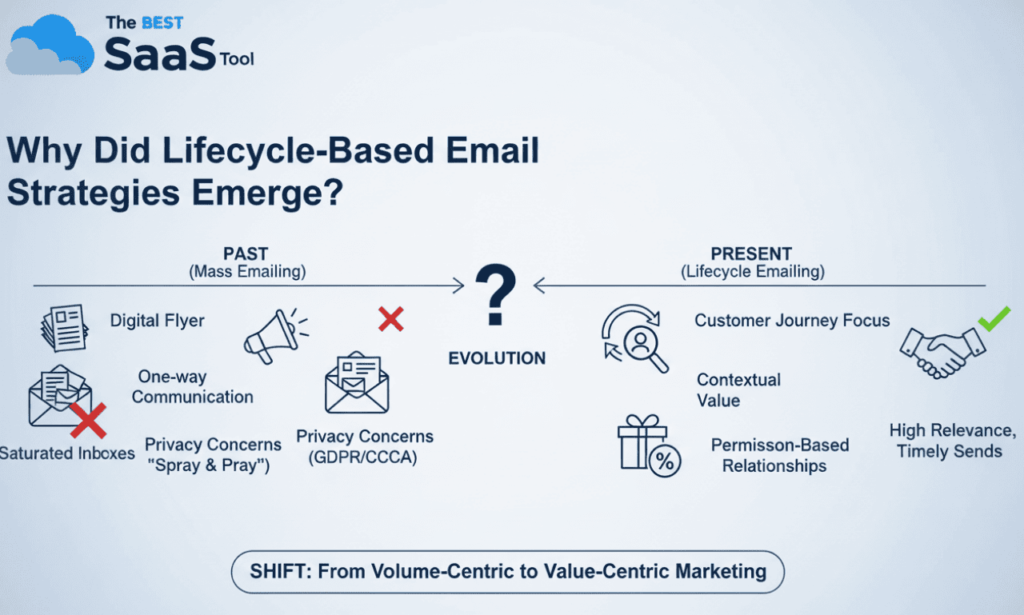
Historically, email was used as a digital flyer—a one-way communication tool meant for mass distribution. However, as inboxes became saturated and privacy regulations like GDPR and CCPA evolved, the “spray and pray” method lost its efficacy.
The concept of the email marketing customer journey emerged as a solution to inbox fatigue. Marketers realized that the value of an email is determined by its context.
A “20% off” coupon is highly relevant to someone in the decision stage but intrusive to a new subscriber who hasn’t yet understood the product’s value proposition. This shift from volume-centric to value-centric marketing allowed brands to build “permission-based” relationships, where every send is anticipated, personal, and relevant.
What Are the Five Critical Stages of the Email Journey?
To build a scalable architecture, you must categorize your subscribers based on their current relationship with your brand. Each stage requires specific LSI keywords and content types to move the needle on performance.
1. The Awareness Stage (The Prospect Journey)
At this entry point, the goal is lead generation and subscriber acquisition. Potential customers are identifying a pain point and looking for educational resources.
- Primary Goal: Convert web traffic into a permission-based lead.
- Key Assets: Lead magnets, gated whitepapers, and newsletter sign-up forms.
- Metric: Form conversion rate.
2. The Consideration Stage (The Nurture Journey)
Once they’ve joined your list, subscribers are evaluating your authority. This is where you address objections and build credibility through social proof.
- Primary Goal: Educate and demonstrate “how-to” value.
- Key Assets: Welcome sequences, case studies, and webinar invitations.
- Metric: Open rates and content engagement.
3. The Decision Stage (The Conversion Journey)
The subscriber is ready to buy but needs a final nudge. This stage is highly sensitive to timing and incentives.
- Primary Goal: Drive the first transaction or trial activation.
- Key Assets: Abandoned cart reminders, limited-time offers, and free trial onboarding.
- Metric: Conversion rate and ROI.
4. The Retention Stage (The Customer Success Journey)
Post-purchase communication is often the most neglected. High-growth brands use this stage to ensure product adoption and reduce “buyer’s remorse.”
- Primary Goal: Increase Customer Lifetime Value (CLV).
- Key Assets: Product tutorials, usage summaries, and “how-to” guides.
- Metric: Churn rate and repeat purchase rate.
5. The Advocacy Stage (The Loyalty Journey)
Happy customers are your best marketers. This stage focuses on turning buyers into brand ambassadors.
- Primary Goal: Generate referrals and user-generated content (UGC).
- Key Assets: Referral program invites, review requests, and VIP sneak peeks.
- Metric: Referral traffic and NPS (Net Promoter Score).
Performance Benchmarks: Email Journey Metrics by Industry
Understanding how your campaigns perform relative to global standards is vital for scalability. The following data highlights the variance in engagement across sectors.
| Industry | Avg. Open Rate | Avg. Click Rate (CTR) | Avg. Bounce Rate |
| Technology / SaaS | 26.80% | 2.65% | 12.50% |
| Retail & E-commerce | 33.80% | 1.11% | 8.81% |
| Education | 39.50% | 2.33% | 9.32% |
| Real Estate | 33.75% | 1.31% | 13.84% |
| B2B Services | 15.14% | 3.18% | 10.20% |
Source: Compiled data from 2025 Industry Performance Reports.
How Do You Map a Journey for Maximum ROI?
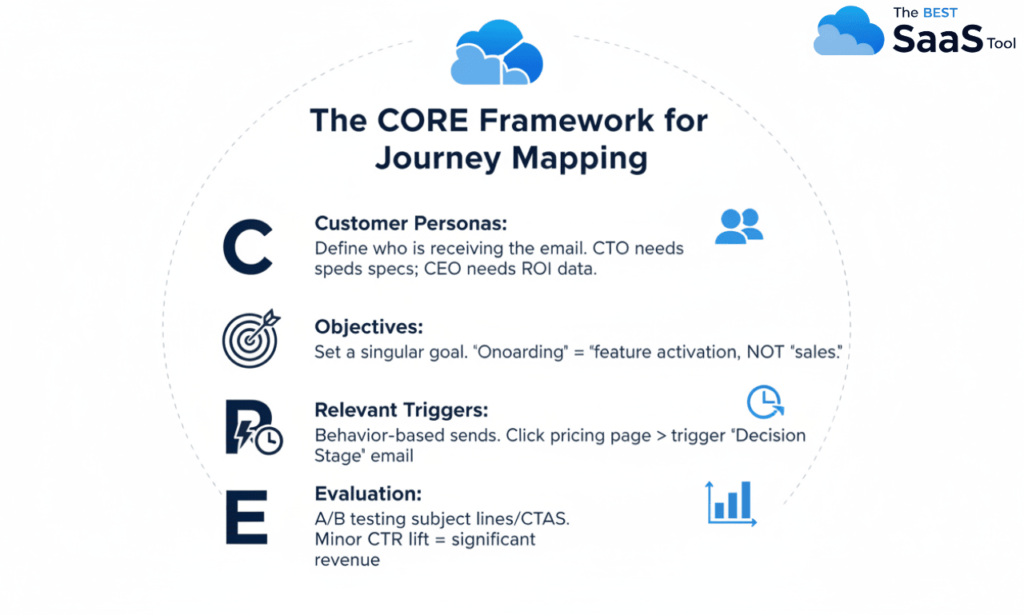
Mapping your email marketing customer journey requires a blend of data science and empathy. Use the CORE Framework to ensure your map remains conversion-ready.
The CORE Framework for Journey Mapping
- C – Customer Personas: Define who is receiving the email. A CTO needs technical specs; a CEO needs ROI data.
- O – Objectives: Set a singular goal for every sequence. If it’s an onboarding flow, the goal is “feature activation,” not “sales.”
- R – Relevant Triggers: Move away from time-based sends to behavior-based triggers. If a user clicks a pricing page, trigger a “Decision Stage” email within 60 minutes.
- E – Evaluation: Use A/B testing to refine subject lines and CTAs. Even a minor lift in CTR can result in thousands of dollars in additional annual revenue.
“The buyer’s journey is the entire experience from pre-purchase to post-purchase. The customer journey refers to your brand’s place within that path: the touchpoints where you meet your customers to solve their pain points.”
— Tamara Grominsky, VP of Product Marketing & Lifecycle.
What Are the Current Standards for Email Security and Scalability?
In 2026, security and deliverability are the silent killers of ROI. If your emails land in the spam folder, your journey map is irrelevant.
- Authentication Protocols: Implement SPF, DKIM, and DMARC to verify your sending domain. This is now a requirement for major providers like Google and Yahoo.
- BIMI (Brand Indicators for Message Identification): Displaying your logo in the inbox improves brand recognition and trust, leading to a 10% increase in open rates.
- Zero-Party Data Collection: With the decline of third-party cookies, use interactive polls and preference centers within your emails to ask customers directly about their interests.
- Accessibility Standards: Ensure your emails are screen-reader friendly by using alt-text for images, high color contrast, and a logical heading structure.
Common Mistakes in Journey Orchestration
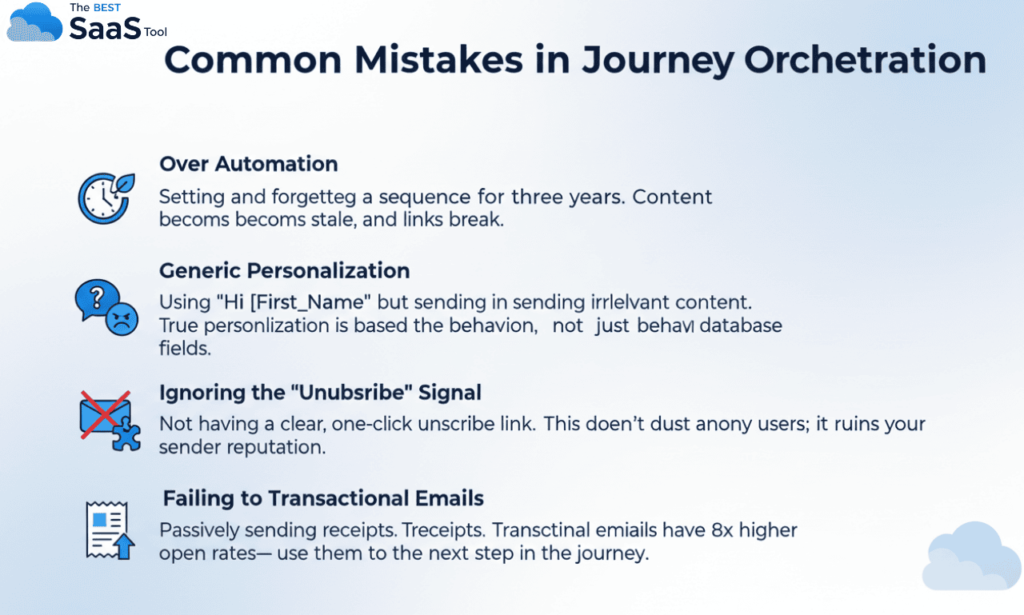
Even seasoned marketers fall into these “journey traps” that can damage brand reputation:
- Over-Automation: Setting and forgetting a sequence for three years. Content becomes stale, and links break.
- Generic Personalization: Using “Hi [First_Name]” but sending irrelevant content. True personalization is based on behavior, not just database fields.
- Ignoring the “Unsubscribe” Signal: Not having a clear, one-click unsubscribe link. This doesn’t just annoy users; it ruins your sender reputation.
- Failing to Segment: Sending a “New User” discount to a customer who has been with you for five years.
- Neglecting Transactional Emails: Passively sending receipts. Transactional emails have 8x higher open rates—use them to suggest the next step in the journey.
What Does the Future of the Email Marketing Customer Journey Look Like?
The next frontier of email marketing is predictive orchestration. We are moving away from “if-this-then-that” logic toward AI models that predict which content a user needs before they even take an action.
- Hyper-Personalization at Scale: Generative AI will allow brands to create unique images and copy for every individual recipient in a list of millions.
- Interactive Inboxes (AMP for Email): Customers will be able to complete purchases, book meetings, or answer surveys directly inside the email without clicking through to a landing page.
- Voice-Activated Previews: As smart speakers become the primary way people “read” their morning briefings, subject lines and preview text will be optimized for audio clarity.
- Omnichannel Integration: The email journey will no longer exist in a silo. An email open might trigger a personalized LinkedIn ad or a SMS notification, creating a seamless 360-degree experience.
Building for Long-Term Value
An email marketing customer journey is not a project; it is a living asset. By focusing on the intersection of data-driven automation and human-centric storytelling, businesses can create a sustainable competitive advantage.
The organizations that win in the long term are those that stop viewing email as a channel for “reaching” customers and start viewing it as a channel for “serving” them.
As you refine your strategy, remember that the most effective journey is the one that respects the recipient’s time while providing undeniable value at every click.
Learn more GetResponse Review: Is This the Best Value Platform in 2026?