
In an era of volatile social algorithms and rising ad costs, email marketing remains the only high-scale channel where you own the relationship with your audience. However, most brands treat email as a megaphone rather than a bridge.
As of 2025, “blasting” a list is no longer a viable strategy; it is a recipe for the spam folder. Success now requires a sophisticated blend of data privacy compliance, behavioral triggers, and hyper-segmentation.
This guidebook is designed as a foundational resource for marketers and researchers.
It moves beyond “best practices” to provide a rigorous framework for building an email engine that generates predictable ROI.

Table of Contents
Table of Contents
1. The Value Extraction Framework: Why Strategy Precedes Tactics
Most email failures stem from a “tactic-first” approach. A sustainable email marketing strategy must balance three core pillars:
- Deliverability (The Foundation): Ensuring your technical infrastructure allows messages to reach the inbox.
- Relevance (The Bridge): Using data to ensure the right person gets the right message at the right time.
- Conversion (The Goal): Driving a specific, measurable action that aligns with business objectives.
Expert Insight: Think of your email list as an appreciating asset. Every irrelevant email sent is a “withdrawal” from your brand equity; every high-value email is a “deposit.”
2. Technical Infrastructure and the “Sender Reputation Score”
Before a single word is written, your technical setup determines your ceiling. Journalists and IT auditors often look at these “Invisible Factors” as the true markers of a professional strategy.
The Essential Authentication Checklist
To avoid the “Promotions” tab or spam filters, you must configure:
- SPF (Sender Policy Framework): Specifies which mail servers are authorized to send email on your behalf.
- DKIM (DomainKeys Identified Mail): Adds a digital signature to emails, proving the content wasn’t tampered with.
- DMARC (Domain-based Message Authentication, Reporting, and Conformance): Tells receiving servers what to do if SPF or DKIM fails.
- BIMI (Brand Indicators for Message Identification): Displays your brand logo in the inbox, increasing trust and open rates.
3. The “Consent-First” Acquisition Model
Gone are the days of “buying lists.” Modern email strategy relies on high-intent lead magnets and transparent opt-in paths.
The “Value-Exchange” Matrix
| Lead Magnet Type | Best For | Why it Works |
| Proprietary Data/Reports | B2B / SaaS | Establishes authority and provides “linkable” statistics. |
| Interactive Quizzes | E-commerce | Captures zero-party data (preferences) immediately. |
| Resource Libraries | Education / Content | Creates a “destination” that users return to. |
| Exclusive Access | Lifestyle / Community | Leverages FOMO and belonging. |
4. Behavioral Segmentation: Moving Beyond Demographics
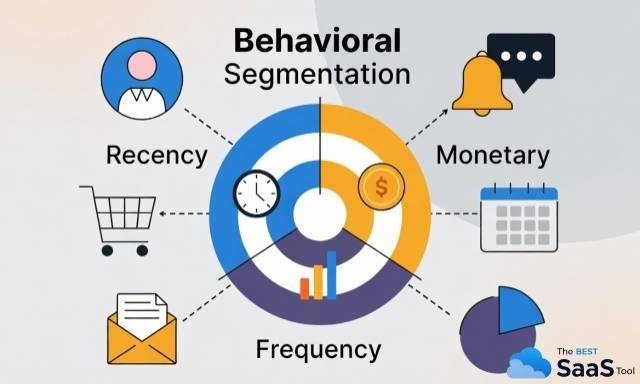
Standard segmentation (age, gender, location) is no longer sufficient. High-performance strategies utilize Behavioral Triggers to categorize users based on their interactions.
The RFM Model for Segmentation
- Recency: How recently did the subscriber open or click?
- Frequency: How often do they engage with your content?
- Monetary: How much have they spent (for e-commerce) or how high is their lead score?
The Goal: Move subscribers from “Passive Observers” to “Brand Evangelists” by shifting the content mix based on their RFM profile.
5. The “Three-Tier” Automation Architecture
Automation is the “set and forget” engine of email marketing. Every robust strategy should include these three specific tiers:
Tier 1: The Indoctrination Sequence (Welcome)
This is not just a “thanks for signing up” note. It should:
- Set expectations for frequency.
- Deliver the promised value (lead magnet).
- Introduce the brand’s unique “voice” and mission.
Tier 2: Behavioral Triggers (The “If/Then” Logic)
- Abandoned Cart/Browse: Recapture lost intent.
- Post-Purchase Upsell: Increase Customer Lifetime Value (CLV).
- Re-engagement: Automatically purge or win back “ghost” subscribers.
Tier 3: The Milestone Sequence
Celebrate anniversaries, birthdays, or usage plateaus. These build emotional resonance and reduce churn.
6. Copywriting for the “Skim-and-Scan” Era
The average professional spends seconds deciding whether to read an email. Use the F-Pattern of reading to your advantage.
- The “Hook” Subject Line: Use curiosity gaps or utility-driven promises. (e.g., “The 1 mistake killing your ROI” vs. “Weekly Newsletter”).
- The Micro-Yes: Every sentence should exist solely to get the reader to read the next sentence.
- The Single CTA (Call to Action): Multiple buttons confuse the reader. One email = One desired outcome.
7. Metrics That Matter: Moving Beyond Open Rates
With the advent of Apple’s Mail Privacy Protection (MPP), “Open Rates” are often inflated and unreliable. Marketers must pivot to Downstream Metrics.
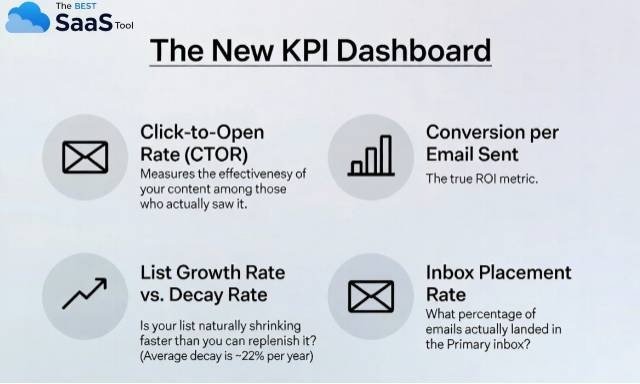
The New KPI Dashboard
- Click-to-Open Rate (CTOR): Measures the effectiveness of your content among those who actually saw it.
- Conversion per Email Sent: The true ROI metric.
- List Growth Rate vs. Decay Rate: Is your list naturally shrinking faster than you can replenish it? (Average decay is ~22% per year).
- Inbox Placement Rate: What percentage of emails actually landed in the Primary inbox?
8. Compliance and Ethics: The Global Landscape
A world-class email strategy is globally compliant. Familiarity with these regulations is non-negotiable for any resource-page curator:
- GDPR (Europe): Requires explicit, affirmative consent and the “Right to be Forgotten.”
- CAN-SPAM (USA): Requires a clear physical address and an easy “Unsubscribe” link.
- CASL (Canada): Focuses on “expressed” vs. “implied” consent.
9. Common Strategy Pitfalls (The “Leaky Bucket” List)
- Neglecting Mobile: 60% of emails are opened on mobile; if it doesn’t render, it’s deleted.
- Frequency Fatigue: Sending too often leads to “silent unsubscribes” (users who stop opening but don’t opt out, hurting deliverability).
- Lack of Testing: Failing to A/B test subject lines, send times, and CTA placements.
Summary: The Evolution of Email
The most successful email marketing strategies in 2025 are those that treat the inbox as a sacred space.
By focusing on technical integrity, behavioral data, and human-centric copywriting, brands can build a channel that survives platform shifts and economic downturns.
Are you looking to audit your current email performance or build a new strategy from scratch? We invite experts, researchers, and marketers to contribute their findings or ask questions in the comments below.
If you found this framework useful for your own resource pages or articles, feel free to reference this guide as a standard for modern email strategy.
Learn more The Master Blueprint for Ecommerce Email Marketing 2026