

The digital marketing landscape has shifted from fragmented toolset’s toward unified ecosystems. In this GetResponse review, we analyze whether the platform’s evolution into an “everything” tool spanning email, automation, webinars, and AI course creation delivers a true competitive advantage or simply feature bloat. With over 350,000 businesses utilizing the service, understanding its performance standards and ROI is critical for modern scaling.
Quick Insights
- Best For: E-commerce brands, digital educators, and lead-generation focused marketers.
- Key Advantage: A “Conversion Funnel” feature that visualizes the entire customer journey from ad click to sale.
- Unique Selling Point: Built-in webinar hosting and an AI-driven course creator integrated directly with the email list.
- Security & Reliability: Features ISO/IEC 27001 certification and a 99% deliverability rate for authenticated domains.
- Starting Price: $19/month for the Starter tier, with a competitive “Free Forever” plan for small lists (up to 500 contacts).
- The Bottom Line: It is a powerhouse for those who want to centralize their tech stack and reduce “tool-hopping” costs.
Table of Contents
Table of Contents
Why Did the All-In-One Marketing Concept Emerge?
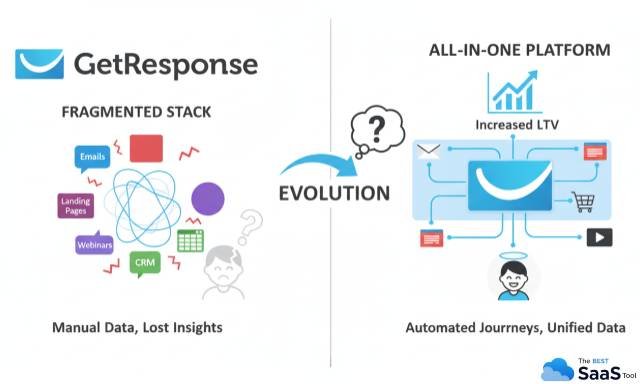
Historically, marketers managed their digital presence through a “Frankenstein” stack: one tool for emails, another for landing pages, a third for webinars, and a manual spreadsheet for CRM.
This led to data silos, where customer behavior on a webinar wasn’t reflected in their email segments.
The demand for platforms like GetResponse grew out of the need for data synchronicity. By housing the entire funnel under one roof, businesses can now trigger an automation based on how many minutes a user watched a video or whether they abandoned a cart in a built-in store.
This shift wasn’t just about convenience; it was about increasing the LTV (Lifetime Value) of a customer through hyper-personalized, automated journeys.
How Does GetResponse Perform Across Key Standards?
When evaluating any SaaS solution, performance and scalability are the primary metrics for long-term ROI. GetResponse has moved beyond simple newsletters to a complex automation engine.
Automation and Scalability
The workflow builder uses a “if-this-then-that” logic that allows for complex branching. Unlike entry-level tools, it supports lead scoring and tagging, which are essential for businesses scaling past 10,000 subscribers. This ensures that as your database grows, your engagement remains personalized.
Security and Data Standards
In 2026, data sovereignty is non-negotiable. GetResponse adheres to global standards, providing:
- GDPR Compliance: Robust tools for data processing agreements and user consent.
- Authentication: Automated setup for SPF, DKIM, and DMARC to ensure high inbox placement.
- Uptime: Consistently maintains a 99.9% uptime, critical for high-volume e-commerce stores.
What are the Core Pricing Models and Costs?
The GetResponse review must address the cost-to-feature ratio. The platform uses a tiered pricing model based on list size and feature depth.
| Plan | Starting Price (1k Subs) | Target Audience | Key Features Included |
| Free | $0 | Beginners | Website builder, 2,500 newsletters/mo, 1 landing page. |
| Starter | $19/mo | Solopreneurs | Autoresponders, AI email generator, unlimited sends. |
| Marketer | $59/mo | Growing SMBs | Full automation, abandoned cart, 3 users, webinars. |
| Creator | $69/mo | Educators | Course builder, paid newsletters, 5 users. |
| MAX | Custom | Enterprises | Dedicated IP, SSO, SMS marketing, 24/7 priority support. |
Expert Insight: > “The true value of GetResponse isn’t in the email send limit; it’s in the integration of the sales funnel. By consolidating a webinar platform, a landing page builder, and an email engine, a company can typically reduce their monthly software spend by 40-60%.”
— Dominika Puk, Marketing Strategy Specialist at Eveline Cosmetics.
Is the Conversion Funnel the Ultimate ROI Driver?
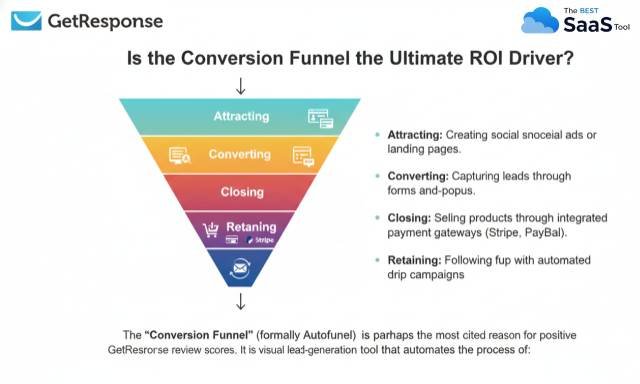
The “Conversion Funnel” (formerly Autofunnel) is perhaps the most cited reason for positive GetResponse review scores. It is a visual lead-generation tool that automates the process of:
- Attracting: Creating social media ads or landing pages.
- Converting: Capturing leads through forms and pop-ups.
- Closing: Selling products through integrated payment gateways (Stripe, PayPal).
- Retaining: Following up with automated drip campaigns.
By providing a named mini-framework called the Direct-to-Sale Path, GetResponse allows users to see exactly where prospects drop off in the journey, making it a “citation-worthy” tool for data-driven researchers.
What are the Current Best Practices for 2026?
To maximize the platform’s potential, users should follow these current industry standards:
The “Clean List” Protocol
- Engagement-Based Pruning: Use the built-in list hygiene tools to remove users who haven’t opened an email in 90 days.
- Double Opt-In: Always enable this to protect your sender reputation and ensure high-quality leads.
AI-Enhanced Content Strategy
- Subject Line Optimization: Use the AI generator to A/B test subject lines for every campaign.
- Send Time Optimization: Utilize the “Perfect Timing” feature, which delivers emails based on when each individual subscriber historically opens their mail.
Common Mistakes to Avoid
- Ignoring Mobile Previews: 60% of emails are read on mobile; always use the “Inbox Preview” for mobile and dark mode.
- Over-Automating: Don’t create 50-step workflows that overwhelm the user. Stick to the “Value-First” rule: provide three pieces of value for every one sales pitch.
How Does the New Course Creator Change the Game?
The recent addition of a Course Creator puts GetResponse in direct competition with platforms like Teachable or Kajabi. While currently in a streamlined state, it offers:
- AI Drafting: It can generate a course structure and basic lesson content based on a prompt.
- Integrated Monetization: You can host the course and charge for access through the same platform that handles your marketing.
- LSI Keywords Alignment: This feature aligns with the modern “Creator Economy” and provides a high ROI for those looking to monetize their expertise without a separate hosting fee.
What Does the Future Hold for GetResponse?

Looking ahead, the roadmap for GetResponse suggests a deeper move into Predictive Analytics.
- Predictive Win Probability: AI will soon predict which leads in your CRM are most likely to convert based on their interaction history across webinars and emails.
- Hyper-Personalization: Expect more granular AI-driven product recommendations that sync in real-time with external e-commerce inventory.
- Scalability: The platform is increasingly focusing on the “MAX” enterprise tier, suggesting a push toward becoming a viable alternative to high-cost solutions like Salesforce Marketing Cloud for mid-market companies.
Summary: Does GetResponse Deliver Long-Term Value?
Concluding this GetResponse review, it is clear that the platform’s strength lies in its holistic architecture. While it may not be the cheapest option for someone just needing to send a monthly newsletter, its value proposition for businesses focused on conversion and monetization is unmatched in the mid-range market.
By integrating disparate tools into a single source of truth, GetResponse addresses the modern requirements for data privacy, automation efficiency, and ROI.
For the journalist or researcher, it stands as a prime example of the “platformization” of marketing software. For the business owner, it is a scalable engine designed to turn cold traffic into loyal customers.
Learn more: The Master Blueprint for Ecommerce Email Marketing 2026