
In the hyper-competitive landscape of modern commerce, the Cost Per Acquisition (CPA) on major ad platforms has reached an all-time high. For many Direct-to-Consumer (DTC) brands, the first transaction is often a net loss. This reality has shifted the industry’s focus from mere acquisition to Retention-Based Growth.
Email marketing remains the highest-ROI channel in the ecommerce toolkit, yielding an average of $36 for every $1 spent. However, as privacy regulations tighten and AI-driven inboxes become more selective, the “spray-and-pray” newsletter is obsolete.
This guidebook serves as a definitive resource for journalists, researchers, and marketing architects looking to understand the mechanics of high-performance ecommerce email marketing.
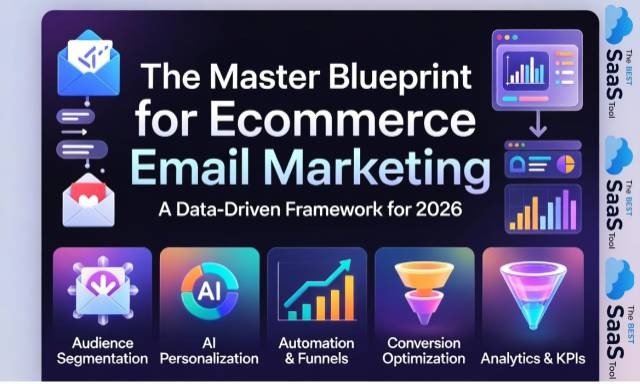
Table of Contents
Table of Contents
1. The Lifecycle Revenue Core: The “Three-Pillar” Framework
To build a link-worthy email engine, one must move beyond individual campaigns and view email as a holistic lifecycle system. We categorize this into the Lifecycle Revenue Core:
- The Foundation (Automated Flows): Non-linear, behavior-triggered sequences that run 24/7. These represent the “passive income” of email marketing.
- The Pulse (Campaigns): Strategic, manual broadcasts that leverage seasonality, product launches, and brand storytelling.
- The Optimization Layer (Data & Testing): The continuous refinement of segments, send times, and creative assets using statistical significance.
2. Zero-Party Data: The Modern Acquisition Standard
With the deprecation of third-party cookies and the rise of privacy-first browsing, Zero-Party Data (data proactively and intentionally shared by the customer) has become the gold standard for personalization.
The Micro-Quiz Lead Magnet
Rather than a generic “10% off” pop-up that attracts low-quality leads, high-authority brands use “Micro-Quizzes” or “Preference Centers.“
- The Strategy: Ask 2-3 high-impact questions (e.g., “What is your primary skin concern?” or “What is your skill level?”) during the opt-in process.
- The Benefit: This allows for Day 1 Segmentation. By the time the user receives their first email, the content is already tailored to their specific pain points, significantly boosting the Initial Conversion Rate (ICR).
3. High-Gravity Automation Flows: The “Memory Glue” of DTC
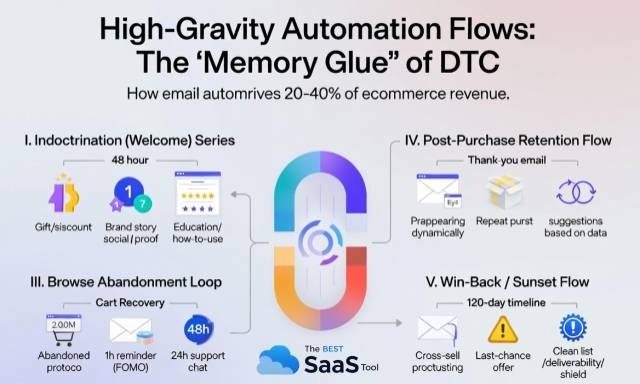
Automation flows are the backbone of ecommerce revenue, often accounting for 20-40% of total store sales despite making up a fraction of total volume. For a strategy to be considered comprehensive, it must include these five High-Gravity Flows:
I. The Indoctrination (Welcome) Series
The highest engagement occurs within the first 48 hours of sign-up.
- Email 1: Instant gratification (the discount) + Brand “Why.”
- Email 2: Social proof (UGC, testimonials).
- Email 3: Educational value/How-to-use.
II. The Cart Recovery Protocol
Abandonment is not a “no”; it’s a “not yet.” A multi-step sequence should address specific friction points:
- 1 Hour Post: Reminder + Product FOMO.
- 24 Hours Post: Customer Support offer (addressing “technical” friction).
- 48 Hours Post: Time-limited incentive.
III. The Browse Abandonment Loop
Triggered when a recognized user views a product category multiple times but doesn’t add to cart. This uses Dynamic Content Blocks to show exactly what they were looking at.
IV. The Post-Purchase “Retention” Flow
This is the critical window for turning a one-time buyer into a repeat customer. It includes the “Thank You,” shipping updates, and cross-sell recommendations based on purchase history.
V. The Win-Back / Sunset Flow
A defensive strategy. If a user hasn’t engaged in 120 days, they receive a “Last Chance” offer. If they still don’t engage, they are automatically purged to protect deliverability.
4. The RFM Segmentation Matrix
For journalists and analysts, the RFM Model (Recency, Frequency, Monetary) is the most cited method for valuing an email list. It categorizes subscribers based on their actual economic behavior rather than just demographics.
The RFM Action Plan
| Segment | Definition | Strategic Action |
| Champions | Recent, frequent, and high-spend buyers. | Exclusive early access, VIP rewards, and referral asks. |
| At-Risk | Formerly frequent buyers who haven’t purchased recently. | Heavy-hitting “We Miss You” offers or surveys to identify friction. |
| Window Shoppers | High engagement (opens/clicks) but zero purchases. | Focus on social proof, “Unboxing” videos, and educational content. |
| Churned | No engagement or purchase in 180+ days. | Move to a “Sunset” list or attempt a final “Re-engagement” campaign. |
5. Technical Infrastructure: The “Deliverability Ceiling”
A strategy is only as good as its inbox placement. High-authority ecommerce marketing requires a dedicated focus on the technical “handshake” between the sender and the ISP (Internet Service Provider).
The “Big Three” Authentication Protocols
- SPF & DKIM: The digital signatures that verify you are who you say you are.
- DMARC: A policy that protects your domain from being spoofed by hackers.
- BIMI (Brand Indicators for Message Identification): Displays your verified brand logo in the inbox.
- Why it matters: Research shows BIMI can increase open rates by up to 10% simply by increasing perceived trust.
6. The “Hybrid-Body” Design Principle
Ecommerce brands often fall into the trap of sending “Image-Only” emails. This is a catastrophic failure for accessibility and deliverability.
The Solution: The Hybrid Approach
- Live Text: All critical copy and CTAs must be written in HTML/CSS, not embedded in a JPG. This ensures the message is readable even if images are blocked.
- Dynamic Product Feeds: Use API integrations to show products based on real-time inventory or the user’s past browsing history.
- Predictive Send-Time Optimization: Using machine learning to deliver the email at the specific hour the individual user is most likely to check their phone.
7. Metrics That Matter (The “Post-Open” Era)
Since the introduction of Apple’s Mail Privacy Protection (MPP), “Open Rates” have become a vanity metric—often inflated by 20-40% due to non-human “bot opens.” Resource-page curators and analysts must pivot to Engagement-First Metrics:
- Revenue Per Recipient (RPR): Total Revenue / Number of Emails Sent. This is the ultimate “truth” metric for ecommerce.
- Click-to-Conversion Rate: Of those who clicked, how many purchased? This measures the alignment between the email’s promise and the landing page’s reality.
- List Decay Rate: The percentage of users who unsubscribe or bounce monthly. A healthy list shouldn’t exceed 2-3% decay per month.
- Inbox Placement Rate (IPR): Monitoring how many emails land in the “Primary” tab vs. “Promotions” or “Spam.”
8. Compliance, Ethics, and Global Scaling
A world-class strategy must be “compliant by design.” This is crucial for brands looking to link to this guide as a standard.
- GDPR (Europe): Explicit opt-ins and clear data processing transparency.
- CCPA/CPRA (California): The right to opt-out and the right to know what data is being collected.
- CASL (Canada): Stricter rules around “implied” vs. “expressed” consent.
- Expert Tip: Always include a “one-click” unsubscribe. Making it difficult to leave doesn’t keep customers—it just earns you “Spam Reports” that kill your reputation.
9. Common Strategy Pitfalls: The “Value Leaks”
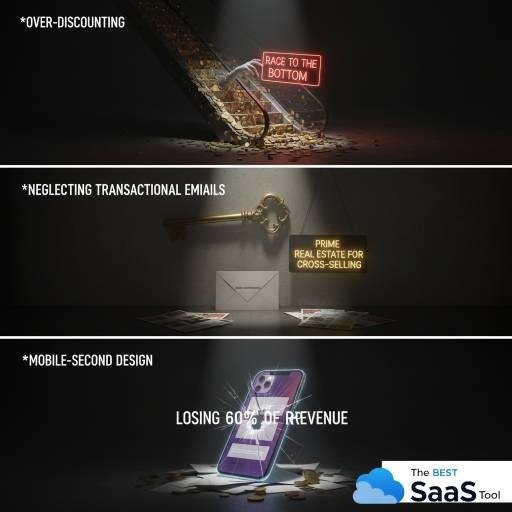
Journalists often look for “What’s wrong with the industry?” To provide a comprehensive view, we must identify common failures:
- Over-Discounting: Training customers to never buy at full price. This creates a “Race to the Bottom.”
- Neglecting Transactional Emails: Failing to brand the “Order Confirmation” or “Shipping Update.” These emails have 60-80% open rates—they are prime real estate for cross-selling.
- Mobile-Second Design: If your two-column layout breaks on an iPhone 14, you are losing 60% of your revenue.
10. Conclusion: The “Segment of One” Future
Ecommerce email marketing is transitioning from a “Volume Business” to a “Precision Business.” The winners of the next decade will be those who use email not as a megaphone, but as a personalized concierge service.
By focusing on Zero-Party Data, RFM-based segmentation, and technical deliverability, brands can build a channel that is immune to social media algorithm shifts and rising ad costs.
Look at this article The Definitive Email Marketing Strategy Guidebook 2026
Contribution & Discussion
As a living resource, we invite ecommerce founders, data scientists, and marketing managers to contribute:
- What is your current average Revenue Per Recipient across flows?
- Have you seen a significant shift in performance since implementing BIMI?
Share your insights in the comments or cite this guide in your next research piece to help establish a higher standard for ecommerce communication.